What does The Hierophant mean in tarot?
The Hierophant is the teacher and spiritual authority of the Major Arcana. Where The Emperor rules the material world, The Hierophant guards the world of belief, ritual and shared values. The word hierophant originally referred to someone who interprets sacred mysteries.
The card is about learning within a tradition: religion, education, family customs, professional standards or any system that passes knowledge from one generation to the next. It speaks to belonging, to commitment and to the comfort of proven paths. It also asks you to decide which inherited beliefs truly belong to you.
The Hierophant card imagery: what the Rider-Waite symbols mean
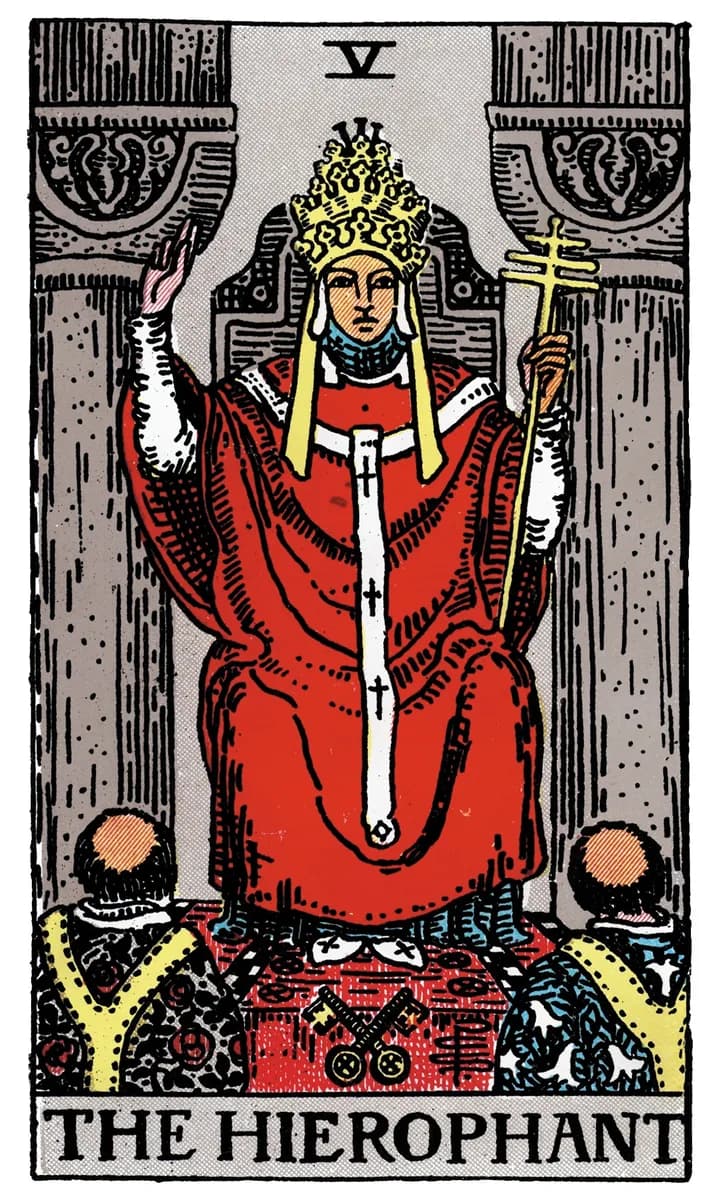
In the Rider-Waite deck, The Hierophant sits enthroned in a temple, dressed in formal red and white robes. His symbols describe spiritual authority and teaching:
- The two gray pillars: structure and the doorway of an established institution, echoing The High Priestess's pillars but in a public setting.
- The raised right hand in blessing: two fingers pointing up, two down, a gesture that links heaven and earth.
- The triple crown: often read as authority over three levels of being, such as body, mind and spirit.
- The triple cross staff: religious authority and the passing down of teaching.
- The crossed keys at his feet: one gold, one silver, the keys to conscious and hidden knowledge. He holds the means to unlock understanding for his students.
- The two kneeling followers: students or initiates receiving guidance, and the idea of knowledge shared in community.
- Red and white robes: action and purity, balanced in his role.
The Hierophant upright meaning
Upright, The Hierophant points to structure through shared belief and established practice. It can mean studying with a teacher, joining a group, following a formal program, or respecting traditions that have value. It is a card of mentors and apprenticeship.
It also highlights conventional choices: marriage, graduation, official ceremonies, contracts and institutions. Now may be a time to follow tested methods rather than reinvent the wheel. The Hierophant asks you to learn the rules well, because mastery of a system is often what later allows you to change it.
A quick example
Suppose you are unsure whether to teach yourself a skill online or join a formal course with a qualified teacher. The Hierophant usually points to the second option. Structure, feedback and the experience of people who walked the path before you will take you further, faster, than going it alone this time.
The Hierophant upright in love
In love, The Hierophant is linked with commitment, traditional relationships and shared values. It can point to engagement, marriage, meeting the family or making a relationship official. It favors partners who share a similar outlook on life.
If you are single, you may meet someone through a community, class, workplace or family connection. The card suggests that common values matter more to you right now than surface excitement. Read more on The Hierophant in love.
More The Hierophant meanings
The Hierophant upright in career
At work, The Hierophant favors established organizations, formal training, certifications and structured career paths. It is a good card for education, law, finance, religion, healthcare and any field with a strong tradition of standards.
It can also point to finding a mentor, or becoming one. Follow the proper channels, learn from people with experience, and build credibility within the system. This is not the moment for shortcuts: steady progress through recognized steps is favored.
The Hierophant upright for money
Financially, The Hierophant recommends conventional, proven approaches. Traditional savings, well-established institutions, and advice from experienced professionals fit this card better than trendy or speculative choices.
It can also point to money matters tied to family, inheritance or institutions. The best move is usually to seek sound guidance. For important decisions, speak with a qualified financial professional.
The Hierophant upright for health and wellbeing
In wellbeing readings, The Hierophant suggests following established, trustworthy guidance rather than trying untested fixes. It favors routines rooted in tradition, such as regular rest, time in community, or practices that have supported people for generations.
It can also encourage you to seek expert advice. Tarot is not medical advice, so for any health concern, please consult a doctor or qualified professional.
The Hierophant spiritual meaning
Spiritually, The Hierophant represents organized spiritual practice, formal teachings and the guidance of a mentor or tradition. It may appear when you are drawn to study a path more deeply, to join a spiritual community, or to take part in rituals and ceremonies.
It also asks what you truly believe. Traditions can offer support, meaning and connection, but faith is strongest when it is understood rather than just inherited. The Hierophant invites you to explore sacred knowledge with both respect and honesty.
The Hierophant reversed meaning
Reversed, The Hierophant points to rebellion and breaking convention. You may be questioning rules, beliefs or institutions that no longer fit, and feeling the need to find your own way. This is not always negative: sometimes growth requires stepping outside the familiar.
It can also warn of dogma on either side: blindly following rules, or rejecting all structure just to be different. The reversed card asks you to think for yourself while staying open to wisdom wherever you find it. See The Hierophant reversed.
The reversed Hierophant can also appear when you have outgrown a teacher or group. Leaving does not have to mean rejecting everything you learned. You can carry forward what was true and still choose a new direction. The card simply asks that your choices be conscious, not automatic, whether you stay inside a tradition or step outside it.
The Hierophant reversed in love
In love, the reversed Hierophant can point to an unconventional relationship, different values between partners, or pressure from family or society about how love should look. It may show a wish to break away from expectations.
It can also reflect a relationship that feels stuck in routine. The question is whether the structure still serves you both. Define your relationship on your own terms, with honesty about what each of you believes and wants.
The Hierophant reversed in career and money
At work, the reversed Hierophant may show frustration with rules, bureaucracy or rigid company culture. It can point to leaving a traditional path to go freelance, start a business or choose an unusual field.
With money, it may suggest trying non-traditional approaches or questioning old family beliefs about money. That can be healthy, but check risks carefully. For major decisions, a qualified financial professional can help you weigh the options.
The Hierophant as feelings
As feelings, The Hierophant shows respect, loyalty and serious intentions. The person may see you as someone they could build a committed, conventional future with, and they value the things you share.
Reversed, it can suggest mixed feelings about commitment or a wish for a less traditional connection. Learn more at The Hierophant as feelings.
The Hierophant as a person
As a person, The Hierophant is a teacher, mentor, counselor or keeper of tradition. They are wise, principled and respected, often part of an institution such as a school, faith community or professional body.
At their best, they guide others generously and pass on real knowledge. At their worst, they can be rigid, preachy or unwilling to consider new ideas. If this card represents you, you may be the one others turn to for guidance.
The Hierophant as advice
As advice, The Hierophant says: seek guidance and learn from those who came before. Find a mentor, take the course, or follow a proven method rather than improvising everything.
At the same time, keep your own values clear. Honor the traditions that support you, and let go of the ones that you only follow out of habit.
If you feel torn, write down the rules you live by and where each one came from. Keep the ones you would choose again today. That list becomes your own personal tradition, built with care rather than inherited by default.
Is The Hierophant a yes or no card?
Upright, The Hierophant leans yes, especially for questions about conventional paths such as marriage, study, formal agreements or joining an organization.
Reversed, the answer leans toward no or toward an alternative route. The conventional option may not be right for you. For more detail, see The Hierophant yes or no.
The Hierophant's element, astrology and numerology
The Hierophant is associated with earth, the element of stability, practicality and lasting forms. Traditions are, in a sense, earthly structures for spiritual ideas.
Its sign is Taurus, a fixed earth sign known for patience, loyalty and a love of what endures. Its Hebrew letter is Vav, often translated as nail or hook, the thing that joins one part to another. It corresponds to path 16 on the Tree of Life, fitting a card that connects the divine and the everyday.
In numerology, 5 is often linked with change and challenge. Here it can show the tension between structure and the need to question it, which is why the card has such a strong reversed meaning.
Cards The Hierophant often appears with
The Hierophant's tradition can be supported or shaken by nearby cards:
- The Hierophant and The Tower: a belief system or institution is suddenly challenged. See The Hierophant and The Tower.
- The Hierophant and The Chariot: disciplined progress along an established path.
- The Hierophant and The Sun: success through learning, graduation or celebration.
- The Hierophant and Wheel of Fortune: traditions meet change, and a new cycle begins.
- The Hierophant and The Lovers: commitment, often marriage or a formal union.
- The Hierophant and the Three of Pentacles: teamwork, apprenticeship and learning a craft.
Affirmation and reflection questions for The Hierophant
Affirmation: I honor the wisdom I have received, and I choose the beliefs that are truly mine.
Journal prompts for when The Hierophant appears:
- Which traditions in my life still support me?
- Which beliefs did I inherit without examining them?
- Who could be a mentor or teacher for me right now?
- Where am I following rules out of fear rather than conviction?