What does the Five of Swords mean?
The Five of Swords is the moment in the Swords suit where ideas turn into arguments. Fives in tarot bring disruption after the stability of the fours, and in the suit of air that disruption happens in words, opinions and pride. The card asks a sharp question: what are you willing to lose in order to win? Its core themes are conflict and winning at a cost, the sting of betrayal or unfair play, and the lesson that not every battle deserves your full strength.
In a spread, the card often lands right where a situation has become heated. It does not always mean you are the one causing trouble. Sometimes it simply names a climate of competition, gossip or mistrust you are standing inside, so you can stop taking it personally and start choosing your response with care.
What is shown on the Five of Swords card?
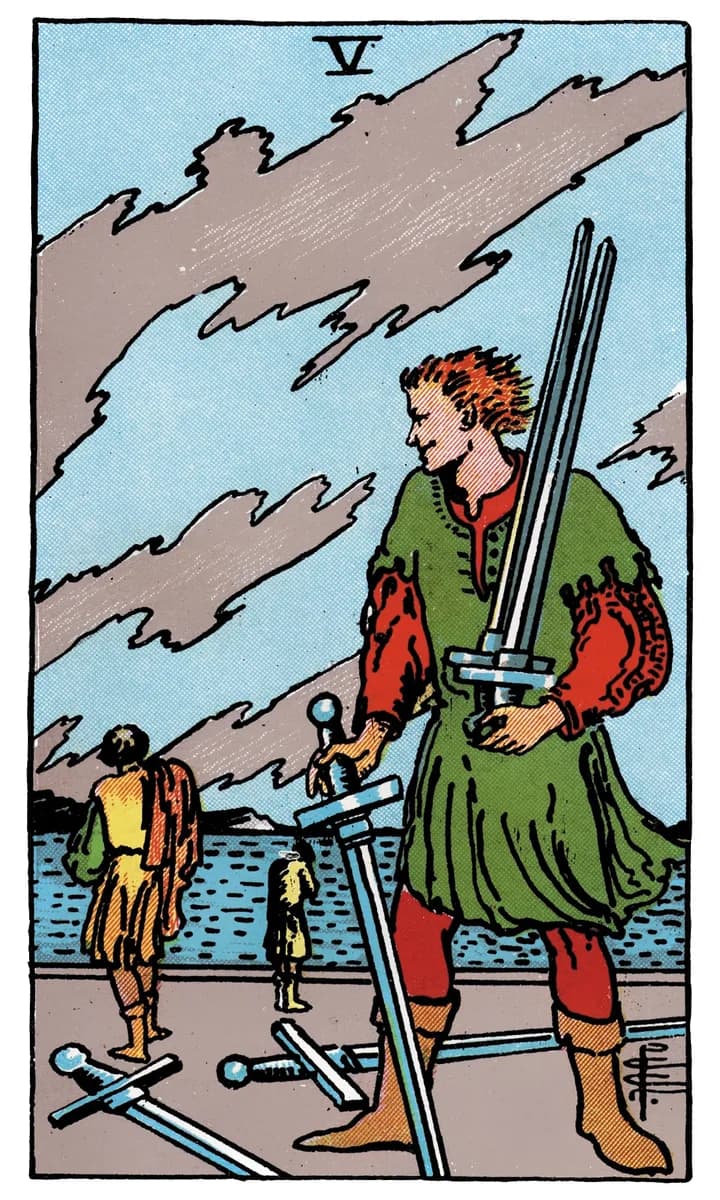
In the Rider-Waite image a young man stands in the foreground holding three swords, with two more lying on the ground at his feet. He looks back over his shoulder with a faint, knowing smile. Behind him two figures walk away toward the water, one with his head bowed and a hand at his face.
- The gathered swords show someone claiming every point, taking more than a fair share.
- The swords on the ground are what was dropped or surrendered in defeat.
- The departing figures carry the emotional cost of the fight.
- The jagged, broken clouds show a stormy mental climate, thoughts stirred up by conflict.
- The choppy water hints that feelings are unsettled beneath the surface.
Five of Swords upright meaning
Upright, this card describes conflict with a winner and a loser, and it rarely feels good for either. You may be in a disagreement where everyone is digging in, or you may have just come out of one feeling strangely empty. Sometimes it warns about someone playing unfairly, bending the rules or twisting words. Other times it points at you, asking whether pride is steering your choices. The card can also carry a sense of betrayal: someone you trusted may have put their own win ahead of fairness.
Notice which figure you relate to most. If you feel like the man holding the swords, the card questions the victory. If you feel like the ones walking away, it acknowledges the hurt and suggests that leaving may be the wisest move available right now.
Five of Swords in love
In a love reading the Five of Swords often shows arguments that go in circles, the silent treatment, or one partner who always needs the last word. It can describe a relationship where keeping score has replaced tenderness. If you are single, it may point to a recent breakup that ended badly or a dating pattern of choosing people who compete rather than cooperate. The honest question here is simple: would you rather be right or be close? You can read more in the Five of Swords love meaning.
More Five of Swords meanings
Five of Swords in career
At work this card appears around office politics, rivalry and credit-taking. A colleague might claim your idea, or a team might split into camps. It can also warn you against winning a debate in a way that burns bridges you will need later. If you are job hunting, the Five of Swords suggests a competitive field, so focus on what you can control and avoid tactics that do not reflect who you are. Sometimes walking away from a toxic environment is the real win. If you manage people, watch for quiet resentment in your team and address unfair workloads before they turn into open conflict.
Five of Swords for money
Financially, the Five of Swords can point to disputes over money: a split bill that turns sour, a disagreement with a business partner, or a deal where someone quietly takes advantage. Read the fine print and keep records. It can also describe money lost through a stubborn decision, like refusing to cut a loss because it feels like admitting defeat. For contracts, debts or legal disputes involving money, it is wise to speak with a qualified professional.
Five of Swords for health and wellbeing
This is not medical advice, but in wellbeing readings the Five of Swords often reflects stress from conflict: tension that sits in the jaw and shoulders, sleep disturbed by replaying an argument, or burnout from constantly defending yourself. It encourages you to notice which battles are draining you and to step back from the ones that do not matter. If stress or low mood is affecting your daily life, please reach out to a doctor or qualified professional.
Five of Swords spiritual meaning
Spiritually, this card is a mirror for the ego. It shows the part of you that needs to win, to be seen as right, to hold all the swords. The lesson is humility: learning when to let go of a point, when to forgive, and when to leave a conflict without needing the final word. Real strength here looks like choosing peace without abandoning your values. Quiet practices such as journaling after an argument, or waiting a day before replying to a harsh message, turn this card from a lesson in loss into a lesson in wisdom.
Five of Swords reversed meaning
Reversed, the Five of Swords reversed moves toward reconciliation and making amends. The fight is ending or has ended, and there is room for reconciliation, apology or simply moving on. It can show you finally laying down an old grudge. In some readings it warns that resentment is still simmering under a truce, so check whether peace is real or just quiet. Either way, the energy is shifting from battle to repair.
The reversed card can also describe a person who has lost a battle and is learning to live with that loss gracefully. There is dignity in accepting an outcome and rebuilding from it, and this card honors that choice.
Five of Swords reversed in love
In love, the reversed card often signals making up after a painful argument, or both people realizing the fight was not worth the distance it created. It can also describe healing after a breakup and accepting that you do not need closure from the other person to move on. If old wounds keep resurfacing, it asks for an honest conversation rather than another round of blame.
Five of Swords reversed in career and money
At work, reversed, the tension eases: a rivalry cools, a dispute is settled, or you decide to leave a situation that kept you on the defensive. With money, it can point to recovering from a loss, settling a debt or accepting a compromise that ends a drawn-out disagreement. The message is to take the lesson and not repeat the pattern.
Five of Swords as feelings
When this card shows how someone feels about you, the emotions are usually tense: resentment, defensiveness, hurt pride or a sense of having been treated unfairly. They may feel they lost an argument with you, or they may feel guilty about winning one. It rarely describes easy warmth. The Five of Swords as feelings page goes deeper into what these reactions can mean.
Five of Swords as a person
As a person, the Five of Swords can describe someone competitive, sharp-tongued and focused on winning, sometimes at the expense of others. At their best they are strategic and unafraid of confrontation. At their worst they manipulate, gloat or refuse to admit fault. It can also describe someone who has just come out of a bruising conflict and is still guarded. In a reading about a new acquaintance, it suggests watching how they treat people when they disagree, because that will tell you more than any first impression.
Five of Swords as advice
As advice, the card says: pick your battles. Ask what winning would actually give you and what it would cost. If the price is a relationship, your integrity or your peace, consider letting this one go. If you are being treated unfairly, protect yourself calmly and without stooping to the same tactics.
Practical steps include cooling off before you speak, writing down what you actually need from the situation, and asking yourself whether the other person could be partly right. A small concession offered early can save a great deal of pain later.
Is the Five of Swords a yes or no card?
The Five of Swords leans no. It suggests that pushing forward will create conflict or that the outcome will feel emptier than you expect. If you are asking whether to confront someone, it says the fight may cost more than it is worth. See the Five of Swords yes or no page for more nuance. A no here is not a punishment. It is an invitation to change the question, perhaps from "Will I win?" to "What would bring this to a fair end?"
Element, astrology and numerology
The Five of Swords belongs to the element of air, the element of thought, speech and conflict of ideas. Astrologically it is linked with Venus in Aquarius (Jan 20 - Jan 29): Venus seeks harmony and connection, while Aquarius values detachment and independence, and that pull between closeness and distance fits a card about people drifting apart after a clash. In numerology, 5 is the number of disruption, instability and change, the push that breaks a comfortable pattern.
Which cards pair with the Five of Swords?
- With The Hermit: stepping away from conflict to reflect, or isolation after a falling out. See Five of Swords and The Hermit.
- With The Hanged Man: a stalemate, and a need to see the conflict from a completely different angle.
- With The Devil: a toxic power dynamic or an argument driven by control and obsession.
- With The Moon: hidden motives, confusion or deception clouding the dispute.
With brighter cards such as the Six of Cups or Temperance nearby, the conflict is likely to soften into understanding. With the Ten of Swords or The Tower, the fallout may be sharper and harder to reverse, so move carefully.
Affirmation and reflection questions
Affirmation: "I choose peace over pride, and I protect my values without needing to win every battle."
Take a few minutes with these questions:
- Which conflict in my life is costing me more than it is giving me?
- Where do I need to be right, and what would happen if I let that go?
- Is there someone I owe an apology to, or someone I need to stop waiting on for one?