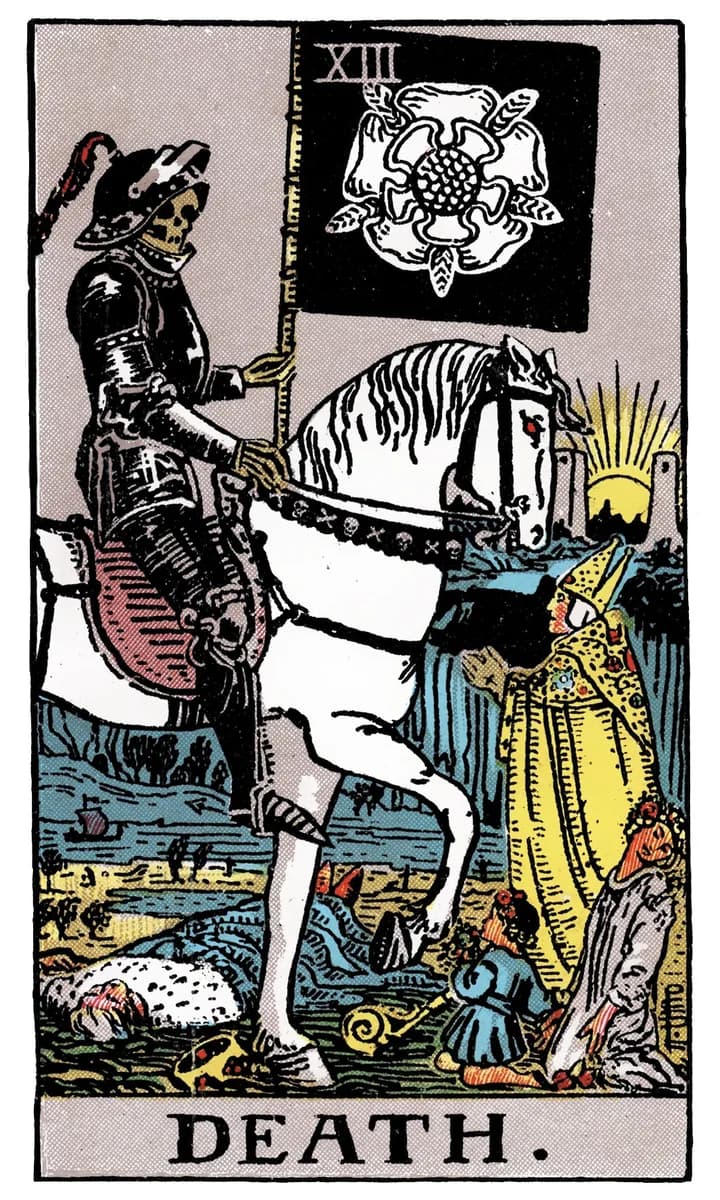
Quick answer: is the Death card a yes or no?
Upright, Death is a no. Specifically, it is a no to holding on. Whatever you are asking about, in its current form, is coming to an end or needs to.
- Upright: no to the situation continuing unchanged. Often a yes to releasing it and making room for what comes next.
- Reversed: also no, but for a different reason. The ending is being delayed, and that delay is creating stagnation.
It is worth saying plainly: the Death card in a reading is symbolic. It speaks about change in relationships, work, habits and identity. The main Death page explains the imagery and the card's long history of being misunderstood.
Why Death leans toward no
Death leans no because its entire job is to close something. You cannot say yes to a new start and yes to the old arrangement at the same time, and this card chooses the new start.
Scorpio. Scorpio is the sign of depth, intensity and transformation. It does not do surface-level change. When Scorpio energy answers a question, it answers from the roots, and the roots are telling you something has run its course.
Water. Water wears things down slowly and reshapes them completely. It points to emotional endings, the kind that happen inside you before they show up outside.
The Hebrew letter Nun. Nun is often linked to the fish, a creature that lives beneath the surface. It suggests renewal that happens out of sight, under the water, before anyone else can see it.
The number 13. Thirteen goes one step past the neat completeness of twelve. It is the number that breaks the pattern, which is exactly what this card does.
Upright Death: no to the old, room for the new
When Death appears upright, the most helpful way to read it is: what is this card asking me to release?
If you asked "Will things go back to how they were?" the answer is no. The old arrangement is finished. If you asked "Should I keep trying to make this work?" the card often suggests that the version you are fighting for has already ended, even if the paperwork has not caught up.
That can sting. It can also be a relief. Many people draw Death after months of sensing that something was over and needing permission to admit it. The card gives that permission.
What the no makes possible
The card's third keyword is release. Releasing a job that drained you, a pattern you kept repeating or an identity you outgrew is how space opens for something that fits. So the upright no often carries a hidden yes: yes to change, yes to growth, yes to what you have not met yet.
One practical tip: when Death answers, write down the question you asked, then write the opposite question underneath. "Will this last?" becomes "Is this ready to end?" You will usually find the card answers the second one with a clear yes, and that version is the one worth acting on.
Reversed Death: a no caused by holding on
Reversed, Death carries the keywords resisting change and stagnation. The answer is still no, but now the no comes from being stuck.
You may know something is over and still be refusing to let it go. Or the situation itself may be lingering in a half-ended state: the relationship that neither person will officially close, the job you have mentally left but still go to every morning, the plan that should have been dropped months ago.
The reversed card warns that trying to preserve what is finished costs energy and time. Things do not improve by being held in place. They just get heavier.
If you asked "Will this situation improve if I wait?" a reversed Death is fairly clear: not by itself. The change it is pointing to will need your cooperation. The kindest step is usually a small one, such as naming the ending out loud, even just to yourself.
Drew Death? Read your exact spread
Add the other cards you drew and your question. Your reading appears in seconds.
Death yes or no in love
In love readings, Death is a no to the relationship as it currently exists. That can mean a breakup, but it does not have to. Sometimes it means the end of a phase: the honeymoon period giving way to something deeper, the end of long distance, the end of a way of relating that no longer works.
For questions like "Will my ex come back?" upright Death leans clearly no. That chapter has closed. For "Is this relationship going to change?" it is a strong yes. For "Should I leave?" it often supports the decision you already sense is right.
Reversed, Death in love frequently points to a relationship that is over in every way but officially. Neither partner wants to be the one to end it, so it drifts.
The Death love meaning looks more closely at how transformation can renew a relationship rather than end it, and how to tell which is happening.
Death yes or no for career and money
At work, upright Death is a no to staying where you are. It often appears when a role, a company or a whole career path is reaching its natural end. It can point to a restructure, a project wrapping up or your own growing certainty that it is time to move on. As an answer to "Should I stay in this job?" it leans no. The Death career page covers how to read this change as an opening rather than a loss.
With money, Death suggests the end of a financial pattern: a debt closing, an income stream finishing, or habits that need to change. It leans no for questions about continuing a current approach, and it encourages clearing out what is no longer working. The Death money meaning gives more detail. For decisions with real financial risk, please speak with a qualified professional.
Reversed, look for where you are keeping a failing arrangement going simply because change feels frightening.
When Death means "not yet"
Death can also say "not yet" to the new beginning you are hoping for. The ending has to finish before the next thing arrives. If you are asking "When will something new come?" the card may be answering: once you have fully let go of the old thing.
The cards around it shape this timing. Death paired with The Fool is one of the more encouraging combinations: an ending followed quickly by a fresh, open start. With The Chariot, the change is driven by your own decision and can move fast once you commit. With The Devil, the delay comes from an attachment or habit that is hard to break, and the not yet lasts until that hold loosens.
If Death gives you a "not yet," the most useful question to ask next is simple: "What am I still holding that I need to put down?"